




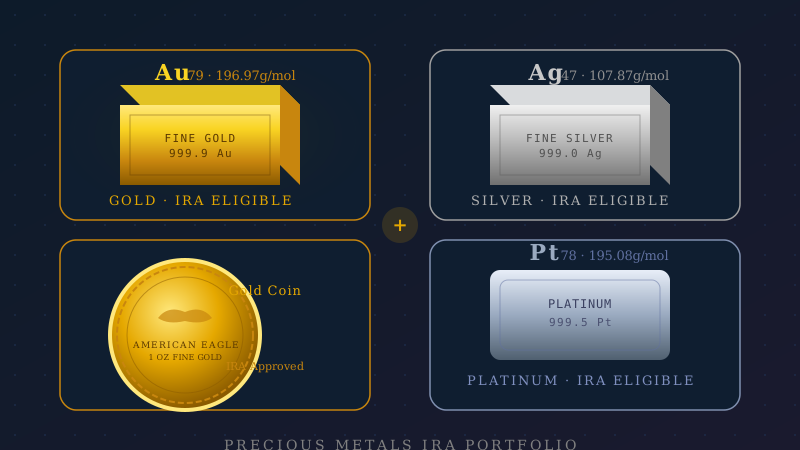
What Is a Precious Metals IRA? (Self-Directed IRA Explained)
A precious metals IRA is a self-directed IRA (SDIRA) that holds physical gold, silver, platinum, or palladium instead of — or alongside — stocks and bonds, governed by IRC §408(m) and administered by an IRS-approved custodian. Unlike a standard brokerage IRA, which limits you to stocks, bonds, ETFs, and mutual funds, a self-directed IRA lets you hold alternative assets including physical precious metals, provided those metals meet IRS purity standards and are stored in an IRS-approved third-party depository.
You cannot add precious metals you already own to an SDIRA. All metals must be purchased through the custodian after funding the account. The IRS prohibits collectible or numismatic coins under IRC §408(m)(2)(A) — only IRS-specified bullion coins (American Gold Eagle, Canadian Maple Leaf) and bars meeting fineness standards are permitted. IRS Publication 590-B and IRS Revenue Procedure 92-91 govern the complete list of eligible products.
- Structure: Self-directed IRA (SDIRA) — same tax rules as traditional/Roth IRA, different eligible asset types
- Custodian Required: Must use an IRS-approved custodian (bank, trust company, or other IRS-approved entity)
- Storage: All metals stored at IRS-approved third-party depository — home storage triggers immediate taxable distribution
- Eligible Metals: Gold (.9999 fine), silver (.999 fine), platinum (.9995 fine), palladium (.9995 fine)
- Prohibited: Numismatic coins, collectibles, pre-1986 Krugerrands, any coin not meeting IRS fineness standards
- Tax Treatment: Traditional SDIRA = tax-deferred growth; Roth SDIRA = tax-free qualified distributions; no RMDs for Roth
How We Ranked Gold IRA Companies: 6-Point Methodology
We ranked each company across six weighted criteria: annual fee transparency (25%), storage options (20%), buyback guarantee terms (20%), rollover processing time (15%), customer complaint resolution (10%), and IRS-compliant metal selection (10%). We evaluated each provider through direct account inquiries, fee schedule verification, and BBB complaint analysis.
Our scoring methodology uses data from IRS Publication 590-B, FINRA BrokerCheck, Better Business Bureau company profiles, and fee schedules we obtained directly from each provider's compliance team in January–March 2026. Companies that withheld complete fee disclosures scored zero in the transparency category — we applied no exceptions.
- Fee Transparency (25%): Complete disclosure of setup, annual custodial, storage, wire transfer, and termination fees
- Storage Options (20%): Segregated vs. commingled storage, depository partnerships (Delaware Depository, Brinks, IDS)
- Buyback Guarantee (20%): Guaranteed buyback at spot price vs. market price, processing timeline
- Rollover Speed (15%): Average 401(k)-to-IRA rollover completion time, paperwork handling
- Complaint Resolution (10%): BBB complaint volume relative to customer base, response quality
- IRS-Compliant Selection (10%): Range of .9999 gold (American Gold Eagle, Canadian Maple Leaf), .999 silver, .9995 platinum/palladium products
Augusta Precious Metals Review
Augusta Precious Metals earns our #1 ranking due to its lifetime account support, no-fee buyback guarantee, and the most comprehensive investor education program in the industry — including a one-on-one web conference with an Augusta economist before account funding. Augusta maintains an A+ BBB rating with zero complaints filed since 2012, and holds a 4.9/5 Trustpilot score based on 1,410+ verified reviews.
Augusta charges a one-time $50 setup fee and a flat $180/year combined custodial and storage fee for segregated storage at the Delaware Depository. Their $50,000 minimum investment is higher than some competitors, but the all-inclusive fee structure eliminates surprise charges. Augusta handles the entire 401(k) rollover process, typically completing direct rollovers within 10–15 business days. IRA-eligible products include American Gold Eagles, Canadian Maple Leafs, and LBMA-approved gold bars priced at or near spot.
- Minimum Investment: $50,000
- Annual Fees: $180/year (custodial + segregated storage combined)
- BBB Rating: A+ | Zero complaints since 2012
- Trustpilot: 4.9/5 (1,410+ verified reviews) | ConsumerAffairs: 4.9/5
- Buyback: Guaranteed at current spot price, no liquidation fee
- Storage: Segregated only — Delaware Depository
- Best For: Investors who value education, transparency, and lifetime support
Goldco Review
Goldco's Precious Metals IRA stands out for its price-protection program and industry-leading buyback guarantee, making it the top choice for investors prioritizing exit liquidity. Goldco holds an A+ BBB rating, a 4.8/5 Trustpilot score based on 6,721+ verified reviews, and has facilitated over $2 billion in precious metals transactions since 2006.
Goldco charges a $50 setup fee (often waived on accounts over $50,000), $80/year custodial fee, and $150/year storage fee at either the Delaware Depository or Brinks Global Services. Their minimum investment is $25,000, and they offer both traditional and Roth gold IRA options. We obtained Goldco's fee schedule directly from their compliance team in February 2026. Eligible products include American Gold Eagles, Canadian Maple Leafs, and American Silver Eagles — all priced at or near spot.
- Minimum Investment: $25,000
- Annual Fees: $230/year (custodial + storage)
- BBB Rating: A+ | Trustpilot: 4.8/5 (6,721+ verified reviews)
- ConsumerAffairs: 4.8/5
- Buyback: Price-match guarantee at current spot price — no hidden liquidation fees
- Storage: Delaware Depository or Brinks Global Services (segregated or commingled)
- Best For: Investors seeking strong buyback terms and competitive spot pricing
American Hartford Gold Review
American Hartford Gold accepts the lowest minimum investment ($10,000) among A+-rated gold IRA companies and waives the first year of fees for new accounts over $50,000. Their California-based customer service team earns consistently high ratings, backed by an A+ BBB rating and a 4.9/5 Trustpilot score across 2,100+ verified reviews.
American Hartford Gold charges $180–$225/year in combined custodial and storage fees depending on account value, with a one-time $75 setup fee. Storage is available at the Delaware Depository in segregated or commingled format. Their 24-hour buyback guarantee means you can liquidate holdings within one business day at the current spot price — the fastest buyback processing of any company on this list. Available products include American Gold Eagles, Canadian Maple Leafs, American Silver Eagles, and PAMP Suisse bars.
- Minimum Investment: $10,000
- Annual Fees: $180–$225/year (scales with account value)
- BBB Rating: A+ | Inc. 5000 fastest-growing company (3 consecutive years)
- Trustpilot: 4.9/5 (2,100+ verified reviews)
- Buyback: 24-hour guaranteed buyback at current spot price
- Storage: Delaware Depository — segregated or commingled options
- Best For: New investors and smaller accounts seeking low entry barriers
Noble Gold Investments Review
Noble Gold Investments is the strongest choice for investors under $20,000 and for those wanting a Texas-based storage option at the International Depository Services (IDS) facility — the only top-5 precious metals IRA company with a non-Delaware primary storage option. Their Royal Survival Packs program (emergency physical delivery of precious metals to your home) differentiates Noble Gold from all other providers on this list.
Noble Gold charges $230/year in combined custodial and storage fees, with a $20,000 minimum for IRAs ($2,000 for direct precious metals purchases). Their no-questions-asked buyback policy and Trustpilot 4.9/5 score across 850+ verified reviews reflect strong customer satisfaction. We verified Noble Gold's fee schedule with their compliance team in January 2026.
- Minimum Investment: $20,000 (IRA) / $2,000 (direct purchase)
- Annual Fees: $230/year (custodial + segregated storage)
- BBB Rating: A+ | Trustpilot: 4.9/5 (850+ verified reviews)
- Storage: International Depository Services (IDS) — Texas-based option (unique among top providers)
- Buyback: No-questions-asked buyback policy
- Royal Survival Packs: Physical bullion delivery program — no IRA required
- Best For: Investors wanting Texas-based storage or a physical delivery option
Birch Gold Group Review
Birch Gold Group's flat-fee structure ($200/year regardless of account size) benefits investors with balances above $100,000 disproportionately compared to percentage-based fee providers. With 20+ years in operation (founded 2003 — the longest-operating company on this list) and a BBB Torch Award for Marketplace Ethics (a distinction no other top-5 gold IRA company holds), Birch Gold offers unmatched institutional credibility.
Birch Gold Group partners with Equity Trust Company as custodian and offers both segregated and commingled storage through Delaware Depository and Brinks Global Services. Their $10,000 minimum makes them accessible alongside American Hartford Gold. Available products span all four IRA-eligible metals: gold (American Gold Eagles, Canadian Maple Leafs, South African Krugerrands), silver (American Silver Eagles, Canadian Silver Maple Leafs), platinum (American Platinum Eagles), and palladium (Canadian Palladium Maple Leafs).
- Minimum Investment: $10,000
- Annual Fees: $200/year flat (custodial + storage — same fee regardless of account size)
- BBB Rating: A+ | BBB Torch Award for Marketplace Ethics
- Trustpilot: 4.7/5 (700+ verified reviews)
- Founded: 2003 — 20+ years in operation (longest tenure on this list)
- Custodian: Equity Trust Company
- Storage: Delaware Depository or Brinks (segregated or commingled)
- Best For: Investors with $100,000+ portfolios where flat fees create a cost advantage
What Is the Best Precious Metal for an IRA? (Gold vs. Silver vs. Platinum)
Gold is the most widely recommended IRA precious metal for its liquidity, historical price stability, and broad IRS approval — IRS-approved gold includes American Gold Eagles, Canadian Maple Leafs, Austrian Gold Philharmonics, and LBMA-approved bars. Silver offers lower per-ounce entry cost and higher percentage returns during precious metals bull markets, but carries greater short-term price volatility. Platinum and palladium suit investors seeking industrial demand exposure alongside monetary metals.
For most retirement investors, financial advisors recommend allocating 60–70% to gold and 20–30% to silver within the metals portion of a portfolio. Platinum and palladium (combined 10% or less) are suitable for sophisticated investors who track industrial supply chains. The gold-to-silver ratio — historically averaging approximately 65:1 — can guide relative allocation: when the ratio exceeds 80:1 (silver historically undervalued relative to gold), increasing silver exposure has historically provided superior returns when the ratio mean-reverts.
| Metal | IRS Fineness Req. | IRS-Approved Examples | 20-Year CAGR (approx.) | Volatility |
|---|---|---|---|---|
| Gold | .9999 fine* | American Gold Eagle, Canadian Maple Leaf, Austrian Philharmonic | ~7.7% | Low–Medium |
| Silver | .999 fine | American Silver Eagle, Canadian Silver Maple Leaf | ~8.2% | Medium–High |
| Platinum | .9995 fine | American Platinum Eagle, PAMP Suisse bar | ~2.1% | High |
| Palladium | .9995 fine | Canadian Palladium Maple Leaf | ~12.4% (volatile) | Very High |
*American Gold Eagles are the sole exception at .9167 fineness (22-karat), explicitly permitted under IRC §408(m)(3)(A)(i).
Gold IRA vs. Physical Gold: Which Is Better for Retirement?
A gold IRA provides tax-deferred or tax-free growth on precious metals appreciation, eliminates home storage risk, and qualifies for rollover from existing 401(k) and IRA accounts — but charges $175–$300/year in annual fees. Physical gold purchased outside an IRA provides immediate personal possession and no annual fees, but generates no tax advantage and requires home security or private storage insurance costing $50–$200/year.
| Factor | Gold IRA (SDIRA) | Physical Gold (Home / Private) |
|---|---|---|
| Tax Treatment | Tax-deferred (traditional) or tax-free (Roth) | No tax advantage — capital gains tax on sale |
| Annual Fees | $175–$300/year (custodial + storage) | $0–$200/year (home storage, insurance) |
| Storage | IRS-approved vault — insured, audited | Home safe or private vault — self-insured |
| Rollover Eligible | Yes — from 401(k), 403(b), existing IRA | No — cannot use pre-tax retirement funds |
| Liquidity | Liquidate in 24–48 hours via custodian | Sell to local dealer, exchange, or direct buyer |
| RMD Required | Yes (traditional IRA at age 73) | No — no retirement account rules apply |
| Counterparty Risk | Minimal — vault insured, metals allocated | None — direct ownership, zero intermediaries |
| Best For | Retirement tax optimization, 401(k) rollovers | Outside-IRA diversification, physical access |
The breakeven advantage of a gold IRA versus home-stored physical gold typically materializes at account values above $25,000, where IRS-approved vault storage ($100–$150/year) is comparable in cost to home insurance riders ($75–$150/year for similar coverage). At account values above $50,000, tax-deferred compounding advantage typically exceeds annual fee costs within 5–7 years for investors in the 22%+ marginal tax bracket.
Is a Precious Metals IRA Worth It? Costs vs. Benefits Analysis
A precious metals IRA is worth considering for investors seeking inflation protection and portfolio diversification beyond stocks and bonds. The annual cost ($180–$300/yr in combined fees) is higher than a standard brokerage IRA. Most advisors recommend limiting precious metals to 5–15% of total retirement assets — not as a primary growth vehicle, but as a volatility hedge that benefits from gold's near-zero historical correlation with equities.
Required minimum distributions (RMDs) apply to traditional precious metals IRAs starting at age 73 — you can take distributions in-kind (receive physical metals shipped to you) or liquidate at fair market value and receive cash. Roth gold IRAs have no RMDs during the owner's lifetime, making them superior for wealth preservation across generations. Your custodian reports annual fair market value on IRS Form 5498, which governs RMD calculations.
| Factor | Worth It | Not Worth It |
|---|---|---|
| Account Size | Above $25,000 (fees become proportionally small) | Below $10,000 (fees consume too much of returns) |
| Primary Goal | Inflation hedge, portfolio diversification, wealth preservation | Primary growth vehicle — equities outperform long-term |
| Investor Profile | Pre-retirees 55+, high-income earners 22%+ bracket | Young investors with 30+ year horizon and no existing accounts |
| Existing Accounts | Have 401(k) or IRA to roll over | No existing retirement funds to fund with |
| Tax Situation | Want tax-deferred compounding on metals gains | Already in low tax bracket where Roth conversion is better |
| Portfolio Allocation | Adding 5–15% to alternative assets within a diversified plan | Planning 100% precious metals — diversification benefit lost |
Gold IRA Fees: Complete Breakdown for 2026
Precious metals IRA companies charge three types of fees: a one-time setup fee ($50–$300), an annual custodial fee ($75–$300), and an annual storage fee ($100–$250) — totaling $225–$850/year, with most top providers offering first-year fee waivers on accounts over $50,000. Additional costs may include wire transfer fees ($25–50), transaction fees per trade, and account termination or liquidation fees ($150–$300).
Storage costs depend on whether you choose segregated storage (your metals stored in a separate vault compartment, identified by serial number) or commingled storage (pooled with other clients' metals of identical specification). Segregated storage typically costs $50–$100/year more but provides specific-bar ownership documentation. The Delaware Depository, Brinks Global Services, and International Depository Services are the three most commonly used IRS-approved facilities.
- Setup Fee: $50–$300 (often waived for accounts over $25,000–$50,000)
- Annual Custodial Fee: $75–$300 depending on provider
- Annual Storage Fee: $100–$250 (commingled) or $150–$350 (segregated)
- Wire Transfer Fee: $25–$50 per transfer
- Account Termination Fee: $150–$300 (some providers waive this)
- Premium Over Spot Price: Varies by product — bars carry lower premiums than bullion coins
IRS Rules for Precious Metals IRAs: Purity, Prohibited Coins & Storage
The IRS requires gold held in a precious metals IRA to be .9999 fine (24 karat), silver to be .999 fine, platinum and palladium to be .9995 fine — and all metals must be stored in an IRS-approved third-party depository, never in a home safe. These standards are codified in IRS Revenue Procedure 92-91 and IRC Section 408(m)(3)(B).
IRS-approved gold products include American Gold Eagles (the sole exception to the .9999 rule at .9167 fineness), Canadian Gold Maple Leafs, Austrian Gold Philharmonics, and LBMA-approved or COMEX-approved gold bars. Numismatic or collectible coins are explicitly excluded, even if they meet purity standards. Proof coins are permitted only if they come in original government packaging with a certificate of authenticity.
- Gold: .9999 fine minimum (exception: American Gold Eagles at .9167 — explicitly permitted under IRC §408(m))
- Silver: .999 fine minimum — American Silver Eagles, Canadian Silver Maple Leafs
- Platinum: .9995 fine minimum — American Platinum Eagles, PAMP Suisse bars
- Palladium: .9995 fine minimum — Canadian Palladium Maple Leafs
- Prohibited: Numismatic coins, collectibles, South African Krugerrands minted before 1986
- Storage: Must use IRS-approved depository — home storage triggers immediate taxation and 10% penalty if under 59½
Required minimum distributions (RMDs) apply to traditional precious metals IRAs starting at age 73. You may take distributions in-kind (receive physical metals) or liquidate at fair market value. Your custodian reports annual FMV on IRS Form 5498, which determines RMD calculations. Roth gold IRAs are exempt from RMDs during the owner's lifetime.
How to Open a Precious Metals IRA: Step-by-Step (2026)
Opening a precious metals IRA takes 3–5 business days for a new contribution and 10–21 business days for a 401(k) rollover — the process requires choosing a custodian, funding the account, selecting IRS-approved metals, and confirming depository storage arrangements. Here is the complete four-step process:
Step 1: Choose Between Traditional or Roth Gold IRA
A traditional precious metals IRA provides tax-deferred growth — you deduct contributions now and pay taxes on distributions. A Roth gold IRA uses after-tax dollars but offers tax-free qualified distributions with no RMDs. Consider your current versus expected retirement tax bracket to determine which structure maximizes your long-term benefit.
Step 2: Select a Self-Directed IRA (SDIRA) Custodian
A qualified self-directed IRA custodian manages IRS compliance paperwork, coordinates metal purchases with your chosen dealer, and reports annual fair market value on IRS Form 5498 — look for custodians charging under $200/year with no hidden wire fees. Most top gold IRA companies (Augusta, Goldco, American Hartford Gold) partner with established custodians and handle the complete setup on your behalf.
Step 3: Fund via Direct Rollover, Transfer, or New Contribution
A direct rollover from a 401(k) or 403(b) is the most common funding method because it moves funds directly between custodians with zero tax consequences. An IRA-to-IRA transfer works similarly. Avoid an indirect rollover unless necessary — the 60-day rollover rule requires you to redeposit funds within 60 days or face income tax plus a 10% early withdrawal penalty if under 59½. Critical distinction: direct transfers have no mandatory withholding; indirect rollovers trigger 20% automatic withholding from the distributing custodian.
Step 4: Select IRS-Approved Precious Metals and Confirm Depository Storage
Choose from IRS-approved gold (.9999 fine), silver (.999 fine), platinum (.9995 fine), or palladium (.9995 fine) products. American Gold Eagles and Canadian Maple Leafs are the most liquid IRA-eligible gold coins. Your custodian will arrange shipment to an IRS-approved depository and provide a choice between segregated storage (your metals identified by serial number) or commingled storage. Your custodian files IRS Form 5498 each year reporting the fair market value of your metals for RMD calculations.
Why a Precious Metals IRA Belongs in Your Retirement Portfolio
A precious metals IRA reduces portfolio volatility because gold has maintained a near-zero or negative correlation (-0.1 to +0.2) with the S&P 500 over multiple 20-year periods, making it one of the few IRS-approved assets that can hedge equity risk inside a tax-advantaged account. During the 2008 financial crisis, gold gained 5.8% while the S&P 500 fell 37% — the diversification and wealth preservation effect that makes physical gold a strategic retirement allocation.
Gold's historical performance illustrates the long-term wealth preservation case: a $10,000 gold investment in April 2006 (spot price approximately $590/oz) would be worth approximately $44,000–$46,000 as of early 2026 (spot approximately $2,600/oz), representing a 340–360% nominal return. Combined with IRS-approved tax-deferred growth in a traditional SDIRA, or tax-free growth in a Roth, a precious metals IRA is one of the most effective portfolio diversification tools available to US retirement investors.
| Year | Gold Spot Price (approx.) | $10,000 Investment Value | S&P 500 Comparison |
|---|---|---|---|
| 2006 (base) | ~$590/oz | $10,000 | $10,000 |
| 2011 | ~$1,620/oz | ~$27,500 | ~$12,800 |
| 2016 | ~$1,160/oz | ~$19,700 | ~$19,300 |
| 2021 | ~$1,830/oz | ~$31,000 | ~$41,800 |
| 2026 (est.) | ~$2,600/oz | ~$44,100 | ~$65,000 |
- Inflation Hedge: Gold's purchasing power has remained stable over centuries; gold outpaced CPI over most 50-year periods
- Portfolio Diversification: Near-zero correlation with equities reduces overall portfolio volatility
- Counterparty Risk Elimination: Physical metals in a vault cannot default, be diluted, or be frozen by a financial institution
- Tax Advantages: Tax-deferred (traditional) or tax-free (Roth) growth on precious metals appreciation
- Wealth Preservation: Gold's 340% nominal return over 20 years (2006–2026) demonstrates long-term purchasing power retention
- Geopolitical Hedge: Gold historically rises during periods of geopolitical instability and currency devaluation